
The Nigerian tech job market in 2026 is clearer than ever — and harder than ever for pure juniors.
Companies are no longer hiring people who only know how to follow tutorials. They want developers who can contribute from week one. Entry-level roles increasingly expect mid-level competencies from two or three years ago.
The good news? The data tells us exactly what those competencies are.
Using live intelligence from InStreamIQ (tracking hundreds of active job postings across Nigerian companies), here’s a practical, no-fluff guide to the skills that actually appear in junior and early mid-level developer roles right now.
1. The Current Reality Check
From InStreamIQ’s July 2026 market data:
- Full Stack Engineer remains the single most in-demand role.
- Backend Engineer and Software Engineer follow closely.
- Backend development postings have grown significantly year-over-year.
- Soft skills (especially communication) are showing explosive growth signals.
Junior developers who only list “React + Node” on their resume are competing against candidates who also show CI/CD awareness, solid SQL, Docker basics, and the ability to communicate clearly across teams.
2. The Highest-Demand Technical Skills for Junior Developers in 2026
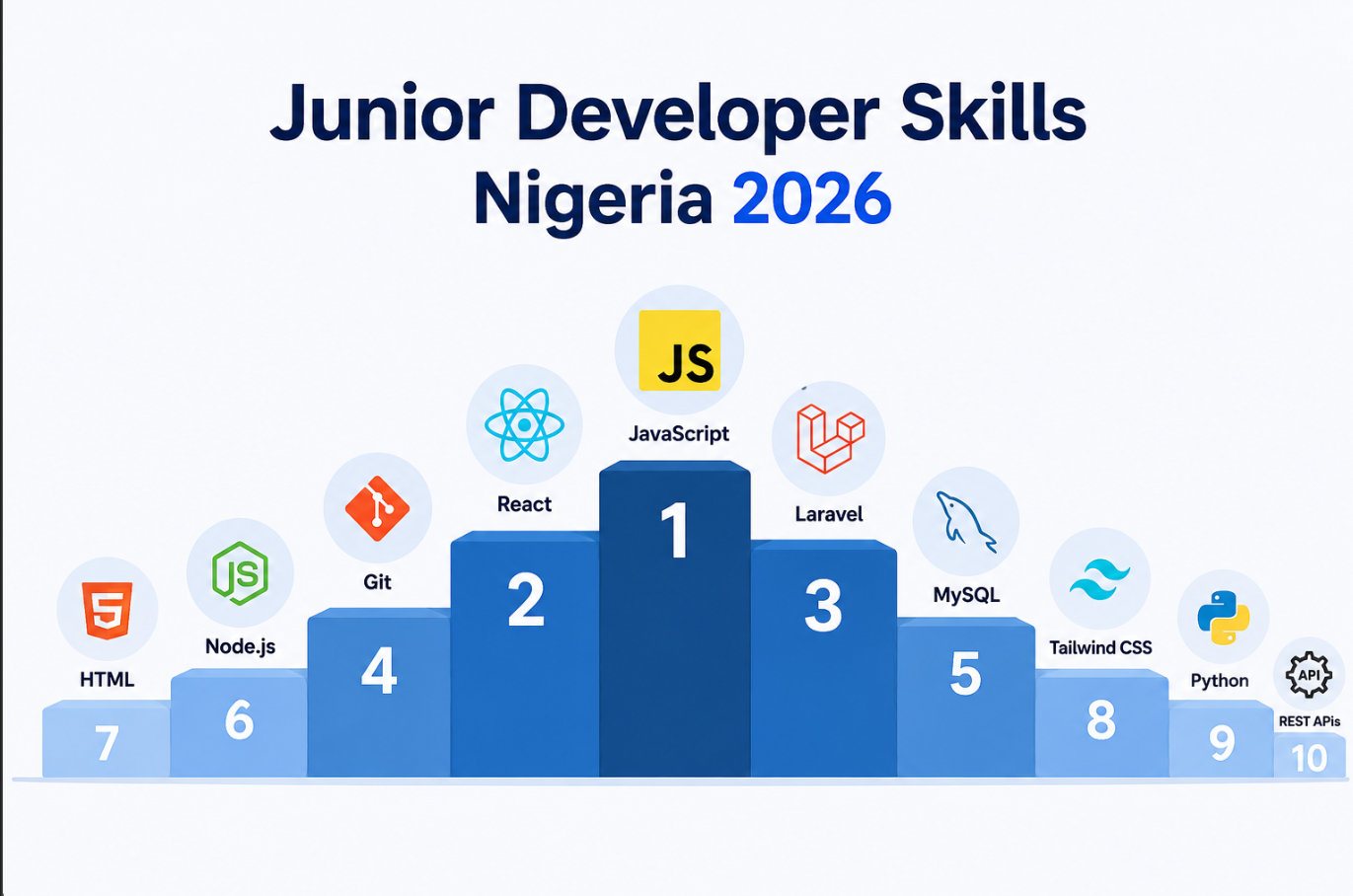
Here are the skills that consistently appear in active job postings for junior and mid-level roles (ranked by real market frequency on InStreamIQ):
| Rank | Skill | Why It Matters for Juniors | Demand Signal |
|---|---|---|---|
| 1 | Agile Methodologies / SDLC | Shows you understand how real teams ship software | #1 overall skill |
| 2 | SQL | Almost every role touches data | Extremely high |
| 3 | CI/CD | Companies want people who understand modern delivery | Very high + trending |
| 4 | AWS (or general cloud) | Cloud-native is the dominant architecture | Strong |
| 5 | Docker | Containerization is now baseline | High |
| 6 | JavaScript / TypeScript | Still the language of the web | High & rising |
| 7 | Python | Backend, data, scripting, and AI adjacency | Strong |
| 8 | Git & GitHub | Non-negotiable collaboration skill | High |
| 9 | Node.js / Express | Core of the MERN stack still widely used | High |
| 10 | React (or solid frontend) | Full-stack expectation is real | High |
Honourable mentions that frequently appear: PostgreSQL/MySQL, Linux basics, API documentation, and Kubernetes awareness (even at junior level).
3. The Soft Skills That Are Quietly Deciding Who Gets Hired
This is where many technically strong juniors lose out.
InStreamIQ data shows Effective Communication and Cross-functional Communication among the fastest-growing skill signals. One recent period showed communication-related demand jumping dramatically.
Employers repeatedly list:
- Ability to explain technical decisions clearly
- Working with product, design, and non-technical stakeholders
- Proactive communication and ownership
- Teamwork and self-motivation
In 2026, being “good at coding but hard to work with” is a career limiter. The developers who can write clean code and explain it to a product manager or document their decisions properly stand out immediately.
4. What “Junior Ready” Actually Looks Like in 2026
A competitive junior developer profile in Nigeria right now typically includes:
Core technical foundation
- Strong fundamentals in at least one language (JavaScript/TypeScript or Python preferred)
- Comfortable with SQL and at least one relational database
- Can build and deploy a full-stack application
- Understands Git workflows beyond “git push”
Modern delivery awareness
- Basic CI/CD concepts (what a pipeline is, why it matters)
- Docker basics (can containerize a simple app)
- Exposure to cloud (AWS free tier experience is enough to start)
Proof of work
- 2–3 real projects (not just tutorials) that solve actual problems
- Clean GitHub with good README files and commit history
- Ability to talk through trade-offs in those projects
Soft skills evidence
- Clear communication in applications and interviews
- Examples of collaborating or taking ownership
5. Practical 90-Day Skill Upgrade Plan for Junior Developers
Month 1 – Foundations + Visibility
- Deepen SQL (joins, indexing, basic optimization)
- Master Git properly (branching strategies, PRs, resolving conflicts)
- Build or improve one full-stack project and deploy it
- Start documenting everything clearly
Month 2 – Delivery & Cloud
- Learn Docker fundamentals and containerize your project
- Set up a simple CI/CD pipeline (GitHub Actions is free and sufficient)
- Get hands-on with AWS free tier (EC2, S3, basic RDS or Lambda)
- Practice explaining your project architecture out loud
Month 3 – Differentiation + Application
- Add TypeScript if you’re on the JS side
- Contribute to an open-source project or collaborate with other developers
- Update your resume and LinkedIn using language that matches job descriptions
- Use tools like InStreamIQ’s resume scoring to see how you match against real openings
6. Salary Context (Nigeria 2026)
Approximate monthly ranges for Lagos-based roles (drawn from market benchmarks correlated with demand data):
- Junior (0–2 years): ₦300,000 – ₦600,000 (higher at strong fintechs or remote roles)
- Early Mid-Level (2–4 years): ₦600,000 – ₦1.3M+
- Remote or international roles can push significantly higher
Fintechs (Moniepoint, Flutterwave, Paystack, Kuda, etc.) and well-funded startups generally pay better than average local companies for the same skill set.
7. Final Advice
The developers who will win in 2026 are not the ones who know the most frameworks. They are the ones who:
- Understand how software is actually delivered in teams
- Can work with data and infrastructure at a basic level
- Communicate clearly
- Show proof through real projects
Focus on depth in the high-signal skills above rather than collecting every new library that trends on Twitter.
The market is competitive, but it is also transparent. The companies are telling you exactly what they need through their job postings. The only question is whether you will listen and act on the data.
Ready to measure yourself against the actual market? Upload your resume on InStreamIQ to get an instant score against current job demand, explore the full skills and roles intelligence, and see which companies are hiring for the exact profile you’re building.
The gap between where you are and where the market is can be closed — but only if you target the right skills.